OPENING QUESTIONS:
Review the characteristics of P, S and Surface waves with your team
LEARNING TARGET: I will read and analyze The Really Big One-- an article that came out about 10 years ago that *rocked* the public's understanding of a Full Rip CSZ event.
NOTE: If you missed class today, please make a copy of that article and read it, highlight and annotate it.
At the very least READ IT
WORDS O' THE DAY:
- Primary (p) waves - Travel through all types of material and arrive first.
- Secondary (s) waves - Only travel through solid rock (not liquids of any sort) and arrive later
- Surface waves - Only travel along the surface of the earth-- they arrive LAST but are most destructive
- focus - The location of an earthquake inside the Earth
- epicenter - The point on the Earth's Surface directly above an earthquake
WORK O' THE DAY:
That article was published about 10 years ago in the New Yorker Magazine.
As you might expect, it caused *quite* the uproar in the Pacific Northwest and a lot of folks thought the article was 'alarmist', 'overblown' and even 'fear mongering'.
That is until they started check with experts in geophysics who basically said, "Yep, that is entirely accurate" (except for one quote that is a bit overblown-- but that is by the person who said it, not the author, and that person was going for shock value (I think).
Having said that, the rest of the article is spot on.
I was teaching Environmental Science in summer school (ICK!) and followed that whole thing with a great deal of interest, to say the least.
To wit:
Your work for today is to read that article FOR CONTENT. That means you are responsible for all of the main topics covered there.
That's a lot.
I'm hoping that you'll also find it extremely informative.
To wit:
I suggest you employ a modified "Mr W Skim Method" for reading that article:
- Read the first paragraph of the article FOR DETAIL, ALWAYS
- Then read the very first line of each succeeding paragraph.
- If that paragraph looks interesting, read it until it isn't, then skip to the next paragraph
- And so on.
- There is a massive amount of very informative information here so be CAREFUL how you skim.
═══════════════════════════
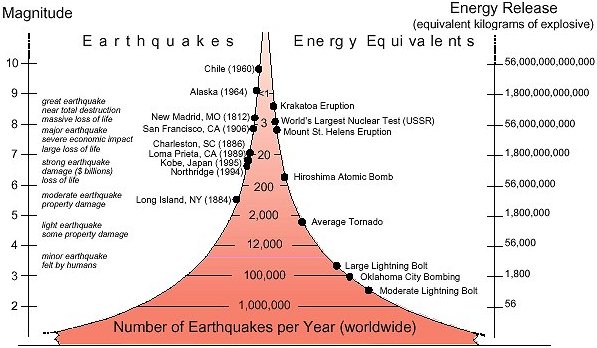
Energy displaced during an earthquake by magnitude (From US Geological Survey):